Yesterday, we had a memorial service for Sonia, my wife's friend since childhood, who died last November. Her family dispersed her ashes in the ocean waters, as Sonia had expressed in her will (I'm paraphrasing her exact words): "to feed the fish, so that she would keep travelling around the world". It was a solemn assembly of about 15 family members and close friends, with words both sad and happy.
Later in the afternoon, more people met in the activity room at the condominium where one of her three close friends lives. Many of her family and friends reminisced about Sonia, our son gave a moving speech about the importance of having close friends, and I think we all reflected on the importance of personal relationships. It was also a happy occasion, because we met many of Sonia's family whom we hadn't seen for some time.
The condominium is located right at the shore of English Bay, with a view across to Vancouver Island; a setting that always appealed to Sonia (as it does to all of us). It was also appropriate, because we could all wish her a "bon voyage".
We had a meaningful get-together.
Monday, May 5, 2008

Saturday, April 26, 2008
Rituals of Spring
When we have a nice Spring day like today, you hear (and see) a lot of people looking after their gardens. This species of individual (Horticulturus nutticus) announces its presence and asserts its territorial imperative by loud humming and buzzing noises, produced by eco-friendly machines such as lawn mowers and weed eaters. He or she spends hours trimming and clipping, planting and weeding, and has fun doing it.
My wife and I (less so) are not immune to the siren call of spring. As I write this, my wife has made plans for me to remove a section of fence (it's just a small piece of plastic lattice in our rose patch in the back of the house) and to put some soil from old flower pots onto the front flower bed. Down the line, I'll be expected to power-wash the back porch and the concrete sections of our back yard. Yes, the rites and rituals of spring require their fulfillment - and I know on which side my bread is buttered.

What we won't do is use commercial grass fertilizers, chemical weed removers, or pesticides on our grass - we also don't water it during summer. The grass is interspersed with moss as well (see picture). Our "lawn" is "un-manicured" and will turn brown here and there when the days get hot, but it always has recovered. I consider drying out a natural event, and the grass seems to be more resilient and resistant to pests because of that. We don't seem to get the "chiggers" that periodically infest our neighbourhood and which crows dig out from underground - and as result, our grass doesn't have the "plowed-up" look.


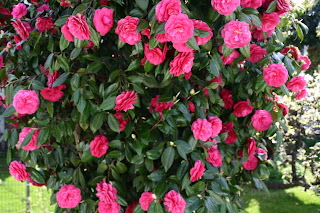 Of course, gardening efforts have as one of their rewards nice looking flowers. Above is a continuation of the evolution of one of the buds on our neighbours' camelia bush. Notice how the branch in front of the flower has grown steadily since the series was started on March 22. The flower is located in the centre of the picture at left, showing more of the camelia bush.
You don't get something for nothing.
My wife and I (less so) are not immune to the siren call of spring. As I write this, my wife has made plans for me to remove a section of fence (it's just a small piece of plastic lattice in our rose patch in the back of the house) and to put some soil from old flower pots onto the front flower bed. Down the line, I'll be expected to power-wash the back porch and the concrete sections of our back yard. Yes, the rites and rituals of spring require their fulfillment - and I know on which side my bread is buttered.

What we won't do is use commercial grass fertilizers, chemical weed removers, or pesticides on our grass - we also don't water it during summer. The grass is interspersed with moss as well (see picture). Our "lawn" is "un-manicured" and will turn brown here and there when the days get hot, but it always has recovered. I consider drying out a natural event, and the grass seems to be more resilient and resistant to pests because of that. We don't seem to get the "chiggers" that periodically infest our neighbourhood and which crows dig out from underground - and as result, our grass doesn't have the "plowed-up" look.


 Of course, gardening efforts have as one of their rewards nice looking flowers. Above is a continuation of the evolution of one of the buds on our neighbours' camelia bush. Notice how the branch in front of the flower has grown steadily since the series was started on March 22. The flower is located in the centre of the picture at left, showing more of the camelia bush.
You don't get something for nothing.
Wednesday, April 23, 2008
Safe?
I just had a look at the pictures of his visit to Burnaby Lake our son posted on Flickr. Among them are some pictures of the main railroad tracks which run near the lake. Here's what caught my eye:

This is safe? Only one spike instead of what obviously calls for two, at least 20mm above the track flange. This is a most heavily used track. What prevents the rail from tipping over when a heavy train travels on them?
Update April 26:
Barbra's comment (below) prompted me to have a quick look at European rail construction. I did a quick search on the internet. Here's what I found almost immediately:

They use concrete ties (no wood) and bolt their tracks to them. I see no "play" between the bolted brackets and the rail. This looks like a seldom used spur line (consider the rust on the top of the rail). The Europeans appear to secure even their little-used tracks in this fashion.

This is safe? Only one spike instead of what obviously calls for two, at least 20mm above the track flange. This is a most heavily used track. What prevents the rail from tipping over when a heavy train travels on them?
Update April 26:
Barbra's comment (below) prompted me to have a quick look at European rail construction. I did a quick search on the internet. Here's what I found almost immediately:

They use concrete ties (no wood) and bolt their tracks to them. I see no "play" between the bolted brackets and the rail. This looks like a seldom used spur line (consider the rust on the top of the rail). The Europeans appear to secure even their little-used tracks in this fashion.
Saturday, April 19, 2008
Another dose of "global warming"


Here we are, at the end of April, and, instead of a nice spring day, we woke up to a scene reminiscent of two months ago. The camelia bush in our neighbours' garden is now in full bloom. This morning, it was crowned with a layer of snow. Looks like more evidence of global warming. The temperature at around 6:30am was a "balmy" -2 degrees Celsius (28F).
.
Well, notwithstanding the above, global warming is real. My concern is that our reaction to it, and the huge emphasis on the warming being caused by human beings, is more political than scientific. The earth has been much warmer than now, and has seen precipitous rises in average temperature many times in the past. We are extrapolating future warming trends based on less than 200 years' worth of reliable measurements, and on assumption-loaded computer model forecasts. We know little about long-term temperature cycles (say of the order of 10,000 - 100,000 years and longer), the effects of changes in the earth's orbit and solar flux variations, etc.
.
By all means, let us be careful in our production of "greenhouse gases", but let's stay logical, instead of spending huge amounts of money on dubious assumptions. Drive less, drive smaller cars, use public transport, walk, use a bike, use less electricity and natural gas in our houses - be "conservative", but let's not panic. I have no doubt that we are contributing to an increase in average temperatures - but to blame humanity for the entire effect is political, not scientific.
Saturday, April 12, 2008
A slow awakening
Over the last three weeks or so, I've taken a series of pictures of two buds on the camelia bush in our neighbour's garden. I used a 200mm telephoto lens from our back porch, and took the photos from essentially the same position every time.
The weather was unseasonably cold for most of the time. In the last few days, temperatures have gone up somewhat, and today was almost like a summer day. Here is the series:
.
.
There are many more buds on that camelia bush, which is located about three meters (10ft) from the edge of our back porch, in our neighbour's garden. The buds are all in various stages of development. When fully in bloom, the camelia bush is a really beautiful sight. Our neighbour looks after her garden and this bush, and we get the enjoyment. You can click on each thumbnail shown here in order to get a larger picture (you'll be transferred into Flickr.com). Feel free to download any or all, if you want .
Monday, April 7, 2008
An evening at the theatre
Last night my wife and I (along with four good friends) attended a performance of "Mama Mia!", a musical built around the compositions of the Swedish group ABBA. While I'm not a theatre-oriented guy, I like ABBA's music. The group produced many world-wide hits in the 70's and 80's, which was the time when my wife and I were in our partying heyday. To this day, the jukebox in our rec (wreck?) room contains their (vinyl) records which we enjoy so much. As an aside, the disco setup in that room is still fully functional, the big twin 15-inch Altec-Lansing speakers, the prototype of the music-driven flashing disco lights which I used to build for hotels and pubs, the amplifiers all still do as well as when I first installed them. Now, our granddaughters play the music and enjoy the party ambiance - it takes us back to the time we had our parties.
Anyway, the performance of the touring group at the Queen Elizabeth Theatre was spectacular. The script has taken the original ABBA lyrics and wrapped a story around them, which essentially involves a current family situation brought about by the permissive atmosphere of the "hippy" age. The perfomers are a very talented group of singers and dancers - the whole performance was vivacious and a little bit ribald. About two dozen of the "ABBA hits" were the backbone of the musical. Funny enough: I think that the slightly "suggestive" character of the performance might not have been allowed on a theatre stage at that time, around thirty years ago.
If you have a chance, go and see it. Our seats were not cheap - we paid $100 apiece. I understand that there is a movie in the works, too; that may be a less expensive way to enjoy this musical. We had a great time.
Anyway, the performance of the touring group at the Queen Elizabeth Theatre was spectacular. The script has taken the original ABBA lyrics and wrapped a story around them, which essentially involves a current family situation brought about by the permissive atmosphere of the "hippy" age. The perfomers are a very talented group of singers and dancers - the whole performance was vivacious and a little bit ribald. About two dozen of the "ABBA hits" were the backbone of the musical. Funny enough: I think that the slightly "suggestive" character of the performance might not have been allowed on a theatre stage at that time, around thirty years ago.
If you have a chance, go and see it. Our seats were not cheap - we paid $100 apiece. I understand that there is a movie in the works, too; that may be a less expensive way to enjoy this musical. We had a great time.
Monday, March 31, 2008
My portable internet
In November, 2007 I enrolled in Rogers' portable internet operation and promised at the time that I'd post something about my ongoing experience later. Well, here we are, a little over four months later, and I'll give you a quick rundown.
Overall, the system has worked. I can recall only one down period, and it didn't last long. Since portable means wireless, the system involves a wireless modem. The signal frequency spectrum is fairly high (in the gigahertz), and for that reason it behaves more like light. This means that you need a more-or-less direct "line of sight" to the transmitter. Personally I don't know where the transmitter to which my modem is "talking" is located, but I get a reasonable strength signal, as indicated by a series of LED's on the modem.
This signal strength appears to be influenced by the weather. I have noticed that, when snow is falling, or when it's raining heavily, the number of active lights on the modem goes from a normal of 4 to 2, sometimes even just one. This seems to affect the connection speed (bandwidth) to some degree. I notice a slowdown especially if I'm watching an on-line movie (for instance, shuttle launches, other NASA "live" broadcasts, or Derek's podcasts). At that time, the buffers on my computer don't load up quickly enough, and the display "stutters".
What accentuates this problem is the in-house networking setup I have. I connect about 4 different computers through a wireless router, which in turn is connected to the wireless modem. In order to maintain security, my network signals, at least those which go "through the air" are all encrypted with WPA keys (some of my computers connect to the router by RJ45 Ethernet cables). The wireless router has to deal with the encrypted signals and other overhead, such as address translations - as do the computers - and that takes time (very short by human standards, but not in the world of computers). In addition, I also have the standard antivirus, firewall, and adware programs running which "analyze" the signals before accepting them. This all contributes to slowing down the received signals.
I've found the speediest reception when I connect one of my laptops directly to the wireless modem via the built-in network card. This connection does not use WPA keys and security is a matter of both my own, and Rogers' protective software arrangements. In most cases, this "wired-to-wireless" connection allows the buffers to "outrace" the playback speed of the movies; you can see the buffer indicator move faster than the playback marker.
So, in my opinion, if portability or independence from wired Internet supplier (ISP) connections is a requirement for you, or if you are unhappy with your current ISP supplier, this wireless arrangement may be useful. The connection speeds are not "blazing", but they are acceptable. If download speed is critical for you, then a wired connection (cable, say), may be better.
Overall, the system has worked. I can recall only one down period, and it didn't last long. Since portable means wireless, the system involves a wireless modem. The signal frequency spectrum is fairly high (in the gigahertz), and for that reason it behaves more like light. This means that you need a more-or-less direct "line of sight" to the transmitter. Personally I don't know where the transmitter to which my modem is "talking" is located, but I get a reasonable strength signal, as indicated by a series of LED's on the modem.
This signal strength appears to be influenced by the weather. I have noticed that, when snow is falling, or when it's raining heavily, the number of active lights on the modem goes from a normal of 4 to 2, sometimes even just one. This seems to affect the connection speed (bandwidth) to some degree. I notice a slowdown especially if I'm watching an on-line movie (for instance, shuttle launches, other NASA "live" broadcasts, or Derek's podcasts). At that time, the buffers on my computer don't load up quickly enough, and the display "stutters".
What accentuates this problem is the in-house networking setup I have. I connect about 4 different computers through a wireless router, which in turn is connected to the wireless modem. In order to maintain security, my network signals, at least those which go "through the air" are all encrypted with WPA keys (some of my computers connect to the router by RJ45 Ethernet cables). The wireless router has to deal with the encrypted signals and other overhead, such as address translations - as do the computers - and that takes time (very short by human standards, but not in the world of computers). In addition, I also have the standard antivirus, firewall, and adware programs running which "analyze" the signals before accepting them. This all contributes to slowing down the received signals.
I've found the speediest reception when I connect one of my laptops directly to the wireless modem via the built-in network card. This connection does not use WPA keys and security is a matter of both my own, and Rogers' protective software arrangements. In most cases, this "wired-to-wireless" connection allows the buffers to "outrace" the playback speed of the movies; you can see the buffer indicator move faster than the playback marker.
So, in my opinion, if portability or independence from wired Internet supplier (ISP) connections is a requirement for you, or if you are unhappy with your current ISP supplier, this wireless arrangement may be useful. The connection speeds are not "blazing", but they are acceptable. If download speed is critical for you, then a wired connection (cable, say), may be better.
Friday, March 28, 2008
Spring and Global Warming


This is "a spring day" in Burnaby. It's been snowing all morning. Should this keep up, people will have to "scrape the global warming off their cars", as one eastern reader's mail to McLean's magazine stated a couple of weeks ago. I don't expect the snow to last - but at the moment it's building up. So far, spring has been quite a bit cooler than average here this year, but considering what the East has had to go through, I'll not complain.
Wednesday, March 26, 2008
Binoculars
As mentioned several times before, I have an abiding interest in astronomy. It is possible to do astronomy without any tools, i.e. telescopes, computers, and the like, but these add more dimensions to this hobby of mine. As a consequence I have accumulated, through my lifetime, several telescopes, computers, cameras, and binoculars.
It may surprise many people, but binoculars have a very useful niche in the application of "visual" astronomy. Galileo would have given his eye-teeth for this kind of "telescope", which binoculars are (actually binoculars are two identical telescopes, one for each eye). Be that as it may, I always use binoculars when I'm out, doing astronomy. As I've gotten older, I have developed a less steady hand; I've found that the tiny tremours in my hands have now come to a stage at which the fine details of what I'm looking at are hard or impossible for me to see. Tripods cure this problem, of course, but they tend to make it awkward to "point-and-look", when checking out the familiar objects in the sky (or on earth, for that matter).

Because of this, I decided to buy yet another pair of binoculars - but this time with the "image stabilizer" option. I opted for a pair of Canon 15x50's (picture at left). This means that the magnification power is 15 and the front lenses are 50mm in diameter. 15 power is normally considered to be beyond the "handheld" range of powers (7 - 10 power is traditionally recommended). However, with the stabilization mode on the Canon binoculars turned on, free-hand use is a real pleasure. The little jiggles disappear, and details become far more obvious.
I'm looking forward to a clear night, so that I can use these binoculars "astronomically", particularly away from the extremely light-polluted sky in this city.
It may surprise many people, but binoculars have a very useful niche in the application of "visual" astronomy. Galileo would have given his eye-teeth for this kind of "telescope", which binoculars are (actually binoculars are two identical telescopes, one for each eye). Be that as it may, I always use binoculars when I'm out, doing astronomy. As I've gotten older, I have developed a less steady hand; I've found that the tiny tremours in my hands have now come to a stage at which the fine details of what I'm looking at are hard or impossible for me to see. Tripods cure this problem, of course, but they tend to make it awkward to "point-and-look", when checking out the familiar objects in the sky (or on earth, for that matter).

Because of this, I decided to buy yet another pair of binoculars - but this time with the "image stabilizer" option. I opted for a pair of Canon 15x50's (picture at left). This means that the magnification power is 15 and the front lenses are 50mm in diameter. 15 power is normally considered to be beyond the "handheld" range of powers (7 - 10 power is traditionally recommended). However, with the stabilization mode on the Canon binoculars turned on, free-hand use is a real pleasure. The little jiggles disappear, and details become far more obvious.
I'm looking forward to a clear night, so that I can use these binoculars "astronomically", particularly away from the extremely light-polluted sky in this city.
Friday, March 21, 2008
A date with Easter
Ever since the Council of Nicea "fixed" the date for Easter, it has almost always occurred at different dates from one year to the next. By the council's definition, Easter occurs on the first Sunday after the first full moon after the spring equinox (which we call the beginning of spring).
As a result, the Easter date can vary by more than a month. This year, it occurs very early (March 23, 2008). The reason is that equinox took place on March 20 at 5:49 Universal Time (UT) - that is, March 19 at 10:49 Pacific Daylight Time (remember, we just switched to PDT on March 8) - and the first full moon after that occurs today (Friday, March 21, which also is "Good Friday" this time) at 18:40 UT (11:40 PDT, about an hour from now, as I write this). The next Sunday occurs the day after tomorrow - so that one is the Easter Sunday.
If the full moon had occurred even just one second before equinox, we would have to wait a full lunar cycle to the Sunday after the following full moon (29.5 days from one full moon to the next, approximately, called a Synodic month) for Easter to happen. If that full moon were to happen on a Monday, we'd have to wait an additional six days to get to the next Sunday - Easter. You do the math for each particular year of your interest.
I'm not addressing the religious aspects of Easter here. It's obvious to me that the Easter date is totally artificial and man-made. But it's interesting to me, because it has to involve astronomical observations and calculations (as most of you who read this blog know, one of my hobbies is Astronomy). The whole thing is an outgrowth of man's preoccupation with the concept of "time" (another anthropocentric idea).
If you're interested in the more detailed aspects of the lunar orbit and the concepts behind our definition of time, an excellent source of information is the "Observer's Handbook", published by the Royal Astronomical Society of Canada. For quick and detailed references, this handbook is used worldwide by amateur and professional astronomers alike. I took the times and dates information above from that handbook.
As a result, the Easter date can vary by more than a month. This year, it occurs very early (March 23, 2008). The reason is that equinox took place on March 20 at 5:49 Universal Time (UT) - that is, March 19 at 10:49 Pacific Daylight Time (remember, we just switched to PDT on March 8) - and the first full moon after that occurs today (Friday, March 21, which also is "Good Friday" this time) at 18:40 UT (11:40 PDT, about an hour from now, as I write this). The next Sunday occurs the day after tomorrow - so that one is the Easter Sunday.
If the full moon had occurred even just one second before equinox, we would have to wait a full lunar cycle to the Sunday after the following full moon (29.5 days from one full moon to the next, approximately, called a Synodic month) for Easter to happen. If that full moon were to happen on a Monday, we'd have to wait an additional six days to get to the next Sunday - Easter. You do the math for each particular year of your interest.
I'm not addressing the religious aspects of Easter here. It's obvious to me that the Easter date is totally artificial and man-made. But it's interesting to me, because it has to involve astronomical observations and calculations (as most of you who read this blog know, one of my hobbies is Astronomy). The whole thing is an outgrowth of man's preoccupation with the concept of "time" (another anthropocentric idea).
If you're interested in the more detailed aspects of the lunar orbit and the concepts behind our definition of time, an excellent source of information is the "Observer's Handbook", published by the Royal Astronomical Society of Canada. For quick and detailed references, this handbook is used worldwide by amateur and professional astronomers alike. I took the times and dates information above from that handbook.
Thursday, March 13, 2008
Back to the cold

My wife and I spent more than a week with friends in Puerto Vallarta, in honour of one of our friend's 80th birthday. A good time was had by all. Mariachis played at the festivities, and everyone enjoyed the renowned Mexican hospitality.
We timed our trip in order to be back when Derek was scheduled for his next chemo treatment (he's suffering the side effects today). It's amazing and encouraging to hear that a number of the people present either had had colon cancer themselves or know people who did. Our 80 year old friend also battled this disease some years back; he knows better than most of us what Derek is going through. What's encouraging is that they are all still alive to tell the tale.
We read Derek's blog while there when we had access to the internet. It kept us just as informed as all other readers of his blog regarding the state of his fight - as his parents, we have a special interest. This is certainly an instance where the internet shines.
Puerto Vallarta is far from the little fishing village it was before the film "The Night of the Iguana", starring Liz Taylor and Richard Burton was made there. Today, P.V. is home to about 400,000 people, and new condos are going up at an unprecedented rate. We had the opportunity to look at a couple of condominium apartments being built next door. They each are 3000+ square feet - 3 bedrooms, 3 bathrooms, a 650 square foot "balcony", in a building with about 170 of them, on the waterfront with a terrific view, and start at about US$570,000. I'm not sure what this will do to the truly Mexican lifestyle in this area, but you can't stop progress - after all, it's happening here, too.
Sunday, March 2, 2008
Cat's Cradle


Yesterday, one of the neighborhood cats decided to settle in one of the flower boxes on our back porch. All the comforts of home? In any case, we're glad to accommodate the regional mouser; it seems that we don't have any rats or mice with which to contend. Perhaps this is due to the cat's vigilance.

Maybe the cat's been visiting for a long time now, without us having noticed it before. Could it be that the nice flowers we have in that flowerbox in spring, summer, and fall owe their looks to the cat?
Saturday, February 23, 2008
Baking Day
This is something of a continuation of the baking procedures first experienced by our granddaughters at Christmas time. The old-fashioned kitchen was again the centre of today's baking activities. We've had our granddaughters stay with us for the last couple of days while Derek and Airdrie were attending the Northern Voice convention at UBC.
Today, the plan was to bake some "pulla bread" again. So, here's how this evolved:


The final result:
It tasted good, too. They even made some for Mom and Dad - sugar-free for him - and, I'm sure, they'll eat a lot of it themselves. As mentioned in the Christmas post, it's nice to see a family tradition carried on.
Today, the plan was to bake some "pulla bread" again. So, here's how this evolved:
The final result:

It tasted good, too. They even made some for Mom and Dad - sugar-free for him - and, I'm sure, they'll eat a lot of it themselves. As mentioned in the Christmas post, it's nice to see a family tradition carried on.
Subscribe to:
Posts (Atom)