Showing posts with label cameras. Show all posts

Sunday, January 8, 2023

Little problems


Living in an area subject to a lot of cloudy weather, I use my telescopes sporadically. The Christmas and New Years' periods additionally result in family and friends getting together. That means that some clear sky conditions are also bypassed. Because of several days being available, I had time in which I could, and did, check the operation and possible problems on my EQ type telescope mounts and my telescopes. 

From my previous blogposts you'll know that I much enjoy the public astronomy nights which SFU runs on clear Friday nights. I've been using my 3" refractor most often for our RASC participation. The telescope is not heavy and can be put onto the telescope mount quickly. As well, it is easy to align with the celestial North Pole. The reason, of course, is the automatic tracking of any object being observed by moving the telescope westward at the same rate as the Earth's rotation eastward.

The EQ4 tracking mount I use for the 3" refractor has somewhat of an issue though. No matter how closely I align the telescope with North, the object in the telescope's field of view slowly drifts out of view. It's easy enough to correct this by using the control buttons on the Dual Axis Motor Drive which powers both the Right Ascension and Declination motors. However, it requires my periodic attention to make sure that our public guests will actually see the target to which I pointed the telescope.

There are many cloudy days and nights at this time of year. I set up the telescope and mount in our recroom at home to move through a 24 hour tracking run. The idea was to set the time and direction scales on the mount to a start point (I pointed the E marker on the telescope RA axis to the 0 hour mark on the time scale) and to read the scales at the end of the run, 24 hours (actually 23 hours, 56 minutes, and 4 seconds) later. At that point I would have expected to see the E marker to point again at the 0 hours mark. Lo and behold, it pointed instead to 2h and 50 min beyond the 0 mark. This means that the telescope actually indicated that it moved past the 0 hour time marker; it incorrectly showed that it had moved a total of 26 hours and 50 minutes. The tracking motion of the mount is therefore 11% faster than the daily sky motion. Since the Earth turns 15 degrees per hour this result moves the telescope to a position almost 45 degrees ahead of  the position it should have after 24 hours tracking, Instead of moving through 360 degrees, it moved almost 405. I had noticed smaller overruns on other days, even on much shorter test runs. This is what actually made me run the 24 hour test.

My motor drive unit has 4 control buttons to speed up the RA and DEC stepper motors 2, 4, or 8 times by means of a separate speed switch. Each button is dedicated to one particular direction. The RA motor is controlled by an East button and a West button, the DEC motor by a North and a South button. The East button can be used to compensate for the 11% excess tracking speed, but it requires me to push and hold the button to move the telescope back to the observed target. It is a very basic and very slow slewing system - it would take many minutes to move from Vega to Deneb for example. As it exists, this whole system is not suitable for long-exposure astrophotography, in my opinion. It's ok for visual observation and possibly photography of the Sun or the Moon.


The dual axis motor drive


proposed astable  timer (below)

Now the question: what causes this? I was thinking about the gear ratios in the RA motor, or in the mount, the clock frequency in the electronics of the Dual Axis motor drive unit, the pulse rate applied to the RA motor stepper windings, searched for an adjustment capability in the electronics board (found none), and other electronic possibilities. I also searched the internet for electronic schematics (there are dozens) but did not find the one which exactly matched the Dual Axis motor drive above. 

I'm thinking of putting together an astable timer based on the 555 precision timer chip. Its output voltage could control the power provided to the motor drive, i.e. shut off power 11% of the time. That way, the movement of the sky could catch up with my faster-moving telescope. It's a crude approach, but in my working days I built many similar timers to control printers, vending machines, debit card readers, and other equipment. I found the timer shown above in one of my "junk"drawers which contain all manner of parts, most of which are decades old. The shown timer is an unused piece I started about thirty years ago, and never finished. I'll check it out and may modify it to counteract the tracking error. 

Stay tuned. .

Monday, June 27, 2022

Life as we know it

 Last Christmas, I received a present from my family, a book by David Attenborough titled "Living Planet, The Web of Life on Earth". The book was chosen by my granddaughter Meredith. She is in her last year of Marine Biology studies at SFU; obviously, the book relates to that.

There are a number of picture plate sections distributed throughout the book. Among them are excellent images of "black smokers", located about 3km below ocean surface, which exude hot, sulphide-laden water, and are the home of several anaerobic species (no sunlight). None-the-less, they are a form of life "as we know it"; they are still DNA-based.


A black smoker (From Wikimedia Commons, the free media repository)

Here's a quote from https://theliquidearth.org/2010/10/black-smokers: Black smokers are black chimney shaped formations that are found in large numbers in “hydrothermal vent fields” in the abyssal and hadal zones of the world’s oceans.  The fields are hundreds of meters wide usually found where tectonic plates below the ocean are moving, where water seeps down into the rocks where it becomes superheated, before returning to the surface where it clouds on contact with the cold ocean water due to the abundance of dissolved minerals in it.  On contact with the cold water, these minerals fall back to the ocean floor forming a chimney structure around the vent.  Because of the large amount of sulphides in the superheated water, sulphide ore deposits are usually found at the base of each chimney. Water at the bottom of the ocean is only around 2oc, the water escaping the chimney of the black smoker can be as high as 400oc (end of quote).

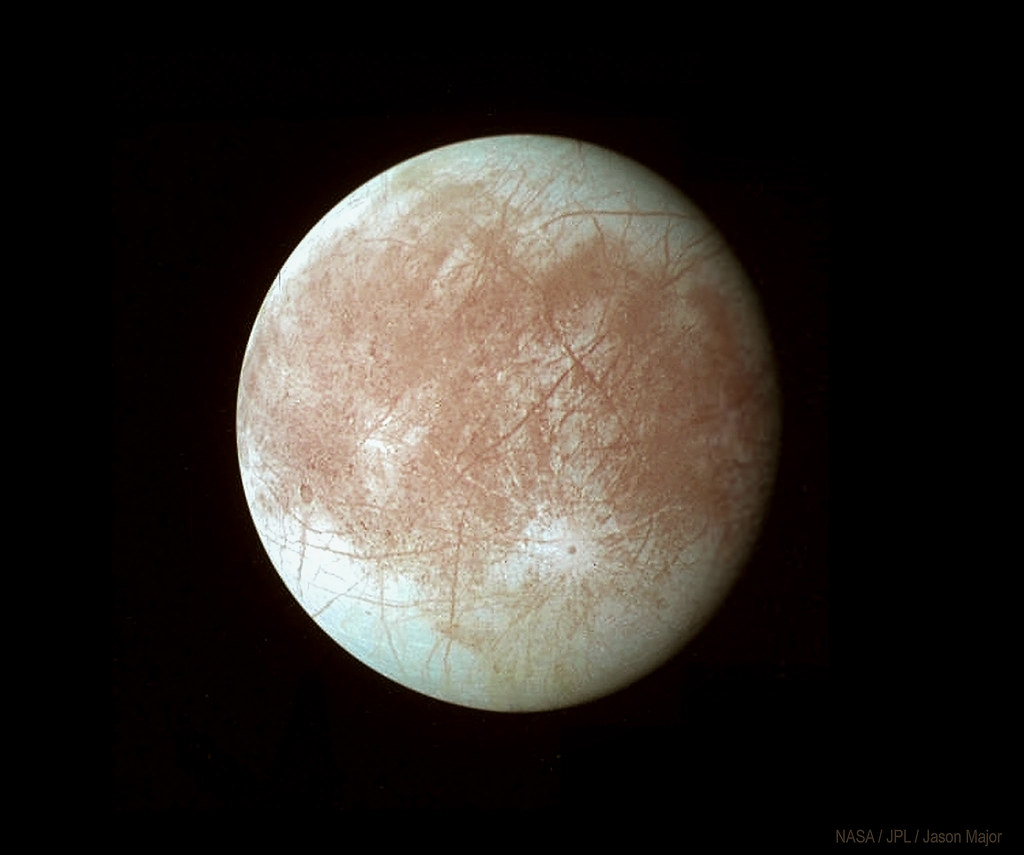
This made me think of the efforts currently being initiated by NASA to send a probe to Europa, the second closest Galilean moon orbiting Jupiter. The name of the probe is Europa Clipper. Fly-bys by an earlier probe (called Galileo) notwithstanding, there's still relatively little known about Europa. This new, in-progress mission, NASA hopes, is going to improve our understanding of that moon. As is quite common, the underlying reason is our search for evidence of possible life elsewhere, other than on Earth. The plan is to launch the probe into space by 2024 to extensively explore Europa from space after arrival in 2031. This multi-orbit exploration will employ a number of various remote-sensing sophisticated sensors. 

The moon Europa appears to be covered by a many-kilometre-thick layer of ice showing cracking ice plates on the surface. Past fly-bys detected characteristics of a deep saltwater ocean below the ice layer, exceeding the amount of water in the oceans here on Earth. A future landing probe would attempt to detect biosignatures of life (as we know it - I can't quite imagine what it would take to recognize a version we DON'T know).

Engineers and technicians inspect the main body of NASA’s Europa Clipper spacecraft

Engineers and technicians unwrap and inspect the main body of NASA's Europa Clipper spacecraft after it was built and delivered by the Johns Hopkins Applied Physics Laboratory(APL) in Laurel, Maryland, to the agency's Jet Propulsion Laboratory in Southern California in early June. Credits: NASA/JPL Caltech/Johns Hopkins APL/Ed Whitman.


Jupiter's moon Europa.  Image Credit: NASA/somagnews.com

At 3,120 km diameter, Europa is the smallest of the four Galilean moons (a bit smaller than our Moon). It orbits Jupiter at a distance of about 671,000 km and is in a resonance relationship with the moons Io and Ganymede. It takes two orbits for Io to go around Jupiter to one orbit for Europa, four Io orbits for one Ganymede orbit. Jupiter itself has the major gravitational effect. These various interactions create complex gravitational flexing of Europa, which is likely to create heat in Europe's interior (to some degree, other Jupiter moons are similarly affected, of course). Perhaps these effects contribute to the cracked appearance of Europa's surface; maybe black smokers exist on Europa also, along with the extremophiles which are the bacterial basis for the existence of the black smoker anaerobic species in our oceans.  

Along with other moons, Europa is also subject to intense radiation which surrounds Jupiter. That situation is not beneficial for life (again, as we know it) on the surface of Europa, but might generate possibilities in the water under the ice shell (maybe turn it into beer?).


Close-up of a rugged area on Europa's surface

Source: NASA/JPL Published January 8, 2019:
During its twelfth orbit around Jupiter, on Dec. 16, 1997, NASA's Galileo spacecraft made its closest pass of Jupiter's icy moon Europa, soaring 124 miles (200 kilometers) kilometers above the icy surface. This image was taken near the closest approach point, at a range of 335 miles (560 kilometers) and is the highest resolution picture of Europa obtained by Galileo. The image was taken at a highly oblique angle, providing a vantage point similar to that of someone looking out an airplane window. The features at the bottom of the image are much closer to the viewer than those at the top of the image. Many bright ridges are seen in the picture, with dark material in the low-lying valleys. In the center of the image, the regular ridges and valleys give way to a darker region of jumbled hills, which may be one of the many dark pits observed on the surface of Europa. Smaller dark, circular features seen here are probably impact craters.North is to the right of the picture, and the sun illuminates the surface from that direction. This image, centred at approximately 13 degrees south latitude and 235 degrees west longitude, is approximately 1 mile (1.6 kilometres) wide. The resolution is 19 feet (6 meters) per picture element. This image was taken on Dec. 16, 1997 by the solid state imaging system camera on NASA's Galileo spacecraft. 

NASA has a link to detailed planned activities during a number of Europa Clipper fly-bys. Here it is: https://europa.nasa.gov/mission/about/


If you own a pair of reasonably sized binoculars (7x50, say) you can easily see the four starlike Galilean moons, and follow their orbits around Jupiter over hours and days. Telescopes will afford you a closer view, depending on the telescope's size. Exact positions, times, and names are listed in the RASC "Observer's Handbook" which contains a multitude of planetary, orbital, scientific data. It is used by both professional and amateur astronomers. If you are a member of the RASC, the handbook is one of the membership bonuses. 

Looking at the Galilean moons, I'm always amazed to think that Galileo's discovery of these moons had a direct effect on, and is perhaps the actual cause of the direction our scientific and cultural evolution has taken since then... life as we know it now.

Friday, April 30, 2021

In thin air


In my previous post, I alluded to the immense engineering resources needed for the very demanding, highly successful landing of a very complex rover vehicle (named Perseverance) on Mars.  

The Perseverance rover on Mars had, as part of the payload, a small, specially designed helicopter to test the possibility of flying in the very thin Martian atmosphere. Ingenuity, the name of  this helicopter, has now flown several times on Mars and met and exceeded all goals set for it, including flying far enough to be almost out of sight of the cameras on Perseverance. By necessity, both Perseverance and Ingenuity have to be autonomous; at this time any control signal from Earth would take about 16 and a half minutes to reach both Ingenuity and Perseverance. Information from NASA/JPL regarding Ingenuity says that this little helicopter exceeded the test performance well beyond expectations.


(Online readers click on image for larger image)

          This is a picture of Ingenuity flying in the distance (label) imaged from the Perseverance rover (Image from NASA and JPL.) 

NASA News indicates an expanded demonstration phase is going to start a couple of weeks from the time of writing (April 30). Ingenuity has proven that its communications, navigation, imaging and other functions are working well, and expanded operations will be initiated. In future, other Mars helicopters will play an ever-expanding role in getting to know far more Mars details. One of the main efforts is to find out whether traces of past or present extraterrestrial life exist now. There are many interesting topological formations on Mars which may be suitable;  an area on Mars in which traces of life (as we know it) could possibly be found: under the icecaps. Martian seasons are similar to Earth, but last about twice as long. Mars is farther away from the Sun, and takes about twice as much time to complete one orbit. 

Below are some of pictures showing the edges of Martian ice caps. The ice caps contain water ice for the most part and are usually covered by CO2 ice (dry ice) during the Martian "winter". The caps melt and rebuild much like on Earth over the span of the Martian "year". Wikipedia contains details regarding Martian polar ice caps.


(Online readers click on image for larger scale)

(Credit for above images: NASA/JPL, Caltech, University of Arizona)

It seems that this rough terrain would be problematic for any rover, but could much more easily be explored by drone-like "Ingenuity" helicopters. 

There is a iGadgetPro YouTube entry showing ice and dust avalanches at the edge of the North Polar ice cap. The images were obtained by NASA's Reconnaissance orbiter's HIRISE camera.


(Online readers click on image for larger scale)

(Credit for above images: NASA/JPL, Caltech, University of Arizona)

When the Sun shines on the layers of the ice caps edges, the warmth makes the ice unstable. Blocks of rock and ice can break off and fall down the about 500m tall edges to create ice and dust clouds when they hit bottom. The colours vary depending on the proportions of dust and ice mixed in these avalanches. 

It always amazes me to see dense clouds of dust in such a thin atmosphere in pictures transmitted from Mars. Well, it made the idea to try flying aircraft on Mars plausible. 


Monday, March 1, 2021

Life on Mars?


The recent landing of the newest Martian Rover (named Perseverance) on February 18, 2021 is truly amazing. The engineering resources deployed to reach this highly difficult goal are overwhelming. Perseverance has as one of its main tasks the finding possible traces of past or present life on Mars. There are several new and proven sensing, imaging, and analyzing devices on board, in addition to others of Mars-proven technologies. Congratulations to everyone who is involved with and contributes to this astounding feat. 

The picture shows a bleak, dry, and waterless landscape, unlikely to be very hospitable to life. But we have images of what appear to be momentary water flows on some Martian crater slopes. We know from past rovers that, in some areas, water ice is present close to the surface. That is a driving reason behind the plans to land people on Mars in future.

Perseverance on Mars (from Space.com)

This landing achievement, the activities planned for this most complex of Martian rovers, and the recent close opposition of Mars in our sky, made me think of a book my mother gave me in 1953, knowing my interest in astronomy. The book's contents address the idea that life of some kind exists everywhere in the universe. Its title is (translated from German) "What lives on the stars"; in it, the author Desiderius Papp describes the intense human fascination with extraterrestrial life during the period in the late 1920s. I had a look into that book again while writing this.

Humanity has for ages "populated" Mars (and the other planets, and some of their moons) with some type of life, usually at least equal, if not superior to us. In the later part of the 1920s a lot of people again speculated about the existence of extraterrestrial life on the planets of our solar system. The beginning of this period seems to have been based on the Mars drawings by the astronomer Giovanni Schiaparelli, who observed Mars for many years in the 1870's and beyond. Some of these drawings show thin lines, which he labelled "canali" (channels), later translated by others as "canals". 

Schiaparelli's visual images were produced using a modest telescope (by today's standards) at an Observatory in northern Italy, working near the limits of its capabilities. As a conscientious observer, he must have had some doubts about the lines he saw, asking himself whether they were optical illusions or real. Many other astronomers of renown never saw these channels. In the 1920's, on and after the 50th anniversary of Schiaparelli's publication of his drawings, the general public got excited over the idea that these supposed canals were the product of highly intelligent and accomplished beings, trying to save their existence by collecting the meltwater from Mars' icecaps; realizing that their planet was rapidly losing its water. 


One of Giovanni Schiaparelli's Mars maps (scienceclarified.com)

It seems that Schiaparelli never promoted those ideas himself (he died in 1910).  However, there were numerous people who expanded this concept, well-known scientists, poets, researchers, and authors of phantasy literature, comics etc., all contributed. One popular astronomer (Camille Flammarion) had no compunctions about stating that these canals were, without a doubt, the result of beings with immensely superior logic and capabilities. Flammarion and other people produced amazingly detailed maps of Mars and the canals, the location of supposedly large cities, possible transportation methods, plant life, many of these ideas amazingly anthropological. One well-known explorer of Mars (Percival Lowell, business man, mathematician, astronomer, author) used his own fortune to build a then state-of-the-art observatory in 1893-1894 at Flagstaff, Arizona, dedicated to the exploration of Mars. He died in 1916, but the Lowell Observatory is still in use today. The observatory's telescope was later used by Asaph Hall, in 1933, to find the then outermost planet in the solar system, Pluto. Hall was also the astronomer who found the two moons of Mars, Phobos and Deimos, in 1877, before the existence of the Lowell Observatory. 

We now know the topology of the Martian surface in reasonable detail. The landscape is indeed complex in many areas, and a number of hints point to the existence of rivers and lakes in the early history of Mars, with canyons and valleys in existence which, however, show no hint of artificial creation. Perhaps Schiaparelli got the first glimpses of something that looked a little like his canali, but we have seen no water canals built by some intelligent and logical beings.

I think that the events referred to above contributed to the path that lead to the efforts referenced at the beginning of this article. We are still looking for life forms that will confirm that we (that is, all life on Earth) are not alone in the universe. From the past and present data sent back by many of the orbiting Mars satellites, on-the-surface moving rovers, and fixed sensing stations, a life as fantasized above is not very likely. At the moment, though, we still cannot answer the questions: is there now or was there ever any life as we know it on Mars? Perhaps any life as we DON'T know it?


Monday, November 30, 2020

An old Workhorse


Since the invention of the telescope and its use for astronomical purposes, the exploration of the universe has progressed at first slowly, and then much faster. That also included advancement in the performance of telescopes themselves. The two main types of telescopes, refractors and reflectors have been around for about 350 years.

Among both types of telescopes, I own one that is my particular favourite. It's a 75mm refractor, purchased used in 1964; its true age I don't know. Here is a picture:


This 75mm, f16 refractor came with a solid wooden equatorial mount tripod (hand-driven tracking). 
The telescope is now mounted on an used EQ5 tripod, purchased about three years ago. 
Right-ascension-tracking and declination motors are powered by a D-battery power pack (not shown).

The telescope has the brand name "Polaris", and someone told me that it is the European version of the "Unitron" brand which was very popular here in North America in the middle of the last century. It has an achromatic objective - chromatic aberration is almost unnoticeable because of the large f-ratio. The telescope produces beautiful views of the major planets, the moon, and open star clusters, but is just on the borderline of dissolving globular clusters into individual stars (i.e. M 13). It's also pretty good at showing the brighter nebulae (Orion nebula, Dumbbell, etc.) and double stars (Mizar, Alcor, the "double double" Epsilon Lyra when pushed to 130 times magnification power, and much more). It's my preferred telescope for Public Astronomy Nights.

In previous centuries, instruments of this size and performance (3", 4", and somewhat larger telescopes) were used to do serious scientific work. For instance, Johann Heinrich von Mädler and Wilhelm Beer produced a highly accurate atlas of the Moon (in four volumes fro 1834 to 1836). It was used by astronomers for over a century.  Mädler  and Beer also produced the first reliable Mars maps and were instrumental (pun intended) in assigning Sinus Meridiani as the Prime Meridian on Mars. Photography was not yet available, so all maps were hand-drawn. Here's an example:  

A part of the "Mappa Selenographica" by Mädler and Beer.

(from planetologia.elte.hu)

Mädler and Beer were also able to determine the rotation period of Mars to within 1.1 seconds. It is highly admirable that astronomers made such demanding observations with telescopes of really moderate size. Even today, refractors built many years ago are still in use for scientific research. 

Photography through my 75mm (3") telescope is also possible. With today's digital cameras and technology it's much easier to take some good pictures. Below is an image of the southern part of the Moon, taken with a handheld Samsung smartphone.  


Handheld smartphone photography through a telescope held against the telescope's eyepiece is difficult, because precisely aligning the optical axes of the smartphone with that of the telescope is mostly a matter of luck. Smartphone holders which attach to a telescope and position the camera lens of a smartphone precisely in line with the telescope eyepiece are available. 

You can see that even old and relatively small telescopes are really useful for getting involved with Astronomy. One additional requirement is a sturdy tripod on which to mount the telescope. It should be included in any telescope purchasing budget. Nothing spoils the performance of telescopes more than a wobbly tripod.

Old workhorses indeed.


Saturday, October 3, 2020

An old Standby

 
In these days of Covid-19, getting together with others to have a look at the night sky is an exercise of don'ts: don't get too close to each other, don't touch or look through the telescope, don't come without a mask, etc. On-line meetings are substituting for the in-person ones. My wife and I are practicing voluntary self-isolation (we are old enough to make this necessary). That means that I'm confined to observing the sky from our home. 
 
We live in a highly light-polluted and horizon-limited area. The smoke from the wildfires in the U.S. has added to the lack of visibility of the stars. There were just a couple of acceptable evenings which led me to look for one of my favorite objects in the sky: The Whirlpool Galaxy not far from the end of the Big Dipper's handle. In a dark sky, M51 can be seen in larger binoculars as a small, diffuse patch of light.

I used my 15x50 Canon stabilized binoculars to try and see it. I did not detect it at all. The gray sky here made it an impossibility.  In earlier years M51 was easy to see from our house; high-rises, new and under construction, now limit our horizon and add much light pollution.

I decided to get my "M51 fix" by posting an image I took a couple of years ago by connecting my computer to Slooh.com to use one of their remotely accessible telescopes and take a picture; below is the result:
 

 Messier 51 
Image taken through the wide-field, 17 inch remote-control Slooh.com telescope located at the Institute of Astrophysics of the Canary Islands. 


 Some history (from Wikipedia):

"What later became known as the Whirlpool Galaxy was discovered on October 13, 1773, by Charles Messier while hunting for objects that could confuse comet hunters, and was designated in Messier's catalogue as M51. Its companion galaxy, NGC 5195, was discovered in 1781 by Pierre Méchain, although it was not known whether it was interacting or merely another galaxy passing at a distance. In 1845, William Parsons, 3rd Earl of Rosse, employing a 72-inch (1.8 m) reflecting telescope at Birr Castle, Ireland, found that the Whirlpool possessed a spiral structure, the first "nebula" to be known to have one. These "spiral nebulae" were not recognized as galaxies until Edwin Hubble was able to observe Cepheid variables in some of these spiral nebulae, which provided evidence that they were so far away that they must be entirely separate galaxies even though they are seen close together. The advent of radio astronomy and subsequent radio images of M51 unequivocally demonstrated that the Whirlpool and its companion galaxy are indeed interacting."

There are still some uncertainties regarding M 51. For instance, the distance of it is variously quoted as 31 million light years (NASA), Wikipedia says about 23 million, universetoday.com states 19 to 27 million light years. A location chart is shown above. A dark sky will allow for M 51 to be seen in 10x50 binoculars as a faint patch of light. An 8" (200mm) telescope will begin to show its spiral structure.

Messier 51 is circumpolar, so it is accessible for most of the year. At this time of year, the Big Dipper skirts the northern horizon through the night. M51 is therefore moves along above the northern horizon as well. Give it a try under a dark sky anyway. Its position will improve as we progress through winter and into next year.