Showing posts with label window views. Show all posts

Monday, June 27, 2022

Life as we know it

 Last Christmas, I received a present from my family, a book by David Attenborough titled "Living Planet, The Web of Life on Earth". The book was chosen by my granddaughter Meredith. She is in her last year of Marine Biology studies at SFU; obviously, the book relates to that.

There are a number of picture plate sections distributed throughout the book. Among them are excellent images of "black smokers", located about 3km below ocean surface, which exude hot, sulphide-laden water, and are the home of several anaerobic species (no sunlight). None-the-less, they are a form of life "as we know it"; they are still DNA-based.


A black smoker (From Wikimedia Commons, the free media repository)

Here's a quote from https://theliquidearth.org/2010/10/black-smokers: Black smokers are black chimney shaped formations that are found in large numbers in “hydrothermal vent fields” in the abyssal and hadal zones of the world’s oceans.  The fields are hundreds of meters wide usually found where tectonic plates below the ocean are moving, where water seeps down into the rocks where it becomes superheated, before returning to the surface where it clouds on contact with the cold ocean water due to the abundance of dissolved minerals in it.  On contact with the cold water, these minerals fall back to the ocean floor forming a chimney structure around the vent.  Because of the large amount of sulphides in the superheated water, sulphide ore deposits are usually found at the base of each chimney. Water at the bottom of the ocean is only around 2oc, the water escaping the chimney of the black smoker can be as high as 400oc (end of quote).

This made me think of the efforts currently being initiated by NASA to send a probe to Europa, the second closest Galilean moon orbiting Jupiter. The name of the probe is Europa Clipper. Fly-bys by an earlier probe (called Galileo) notwithstanding, there's still relatively little known about Europa. This new, in-progress mission, NASA hopes, is going to improve our understanding of that moon. As is quite common, the underlying reason is our search for evidence of possible life elsewhere, other than on Earth. The plan is to launch the probe into space by 2024 to extensively explore Europa from space after arrival in 2031. This multi-orbit exploration will employ a number of various remote-sensing sophisticated sensors. 

The moon Europa appears to be covered by a many-kilometre-thick layer of ice showing cracking ice plates on the surface. Past fly-bys detected characteristics of a deep saltwater ocean below the ice layer, exceeding the amount of water in the oceans here on Earth. A future landing probe would attempt to detect biosignatures of life (as we know it - I can't quite imagine what it would take to recognize a version we DON'T know).

Engineers and technicians inspect the main body of NASA’s Europa Clipper spacecraft

Engineers and technicians unwrap and inspect the main body of NASA's Europa Clipper spacecraft after it was built and delivered by the Johns Hopkins Applied Physics Laboratory(APL) in Laurel, Maryland, to the agency's Jet Propulsion Laboratory in Southern California in early June. Credits: NASA/JPL Caltech/Johns Hopkins APL/Ed Whitman.
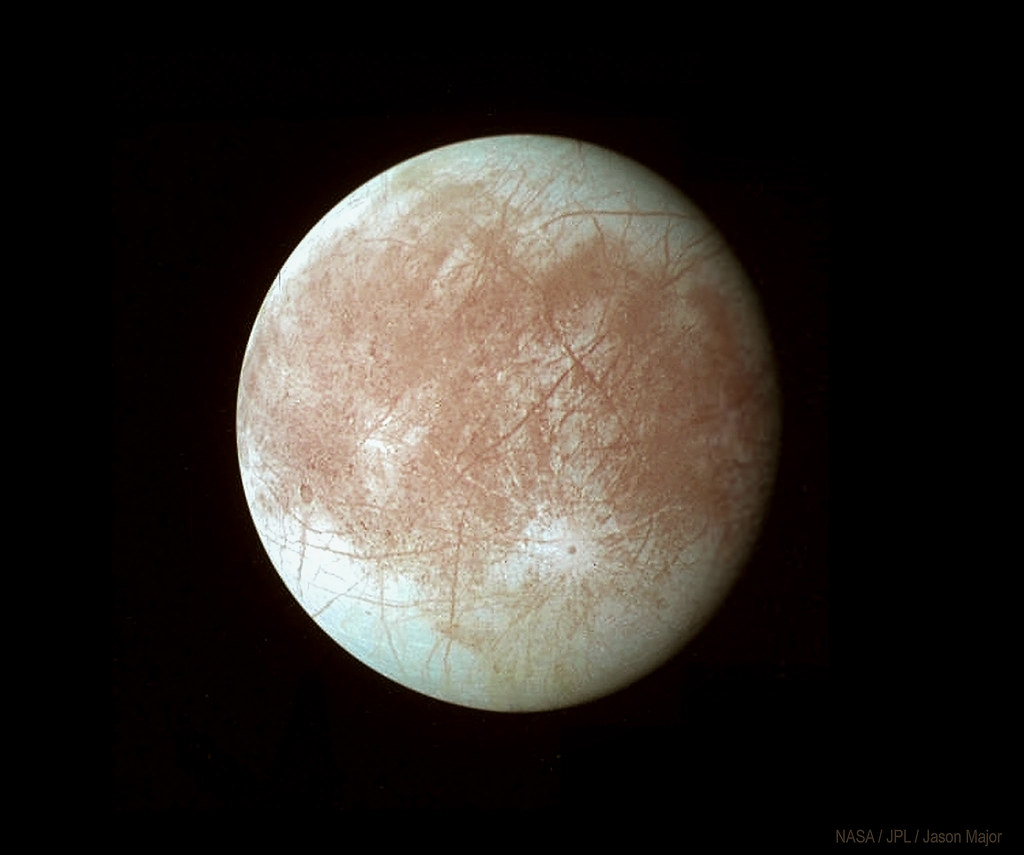
 

Jupiter's moon Europa.  Image Credit: NASA/somagnews.com

At 3,120 km diameter, Europa is the smallest of the four Galilean moons (a bit smaller than our Moon). It orbits Jupiter at a distance of about 671,000 km and is in a resonance relationship with the moons Io and Ganymede. It takes two orbits for Io to go around Jupiter to one orbit for Europa, four Io orbits for one Ganymede orbit. Jupiter itself has the major gravitational effect. These various interactions create complex gravitational flexing of Europa, which is likely to create heat in Europe's interior (to some degree, other Jupiter moons are similarly affected, of course). Perhaps these effects contribute to the cracked appearance of Europa's surface; maybe black smokers exist on Europa also, along with the extremophiles which are the bacterial basis for the existence of the black smoker anaerobic species in our oceans.  

Along with other moons, Europa is also subject to intense radiation which surrounds Jupiter. That situation is not beneficial for life (again, as we know it) on the surface of Europa, but might generate possibilities in the water under the ice shell (maybe turn it into beer?).


Close-up of a rugged area on Europa's surface

Source: NASA/JPL Published January 8, 2019:
During its twelfth orbit around Jupiter, on Dec. 16, 1997, NASA's Galileo spacecraft made its closest pass of Jupiter's icy moon Europa, soaring 124 miles (200 kilometers) kilometers above the icy surface. This image was taken near the closest approach point, at a range of 335 miles (560 kilometers) and is the highest resolution picture of Europa obtained by Galileo. The image was taken at a highly oblique angle, providing a vantage point similar to that of someone looking out an airplane window. The features at the bottom of the image are much closer to the viewer than those at the top of the image. Many bright ridges are seen in the picture, with dark material in the low-lying valleys. In the center of the image, the regular ridges and valleys give way to a darker region of jumbled hills, which may be one of the many dark pits observed on the surface of Europa. Smaller dark, circular features seen here are probably impact craters.North is to the right of the picture, and the sun illuminates the surface from that direction. This image, centred at approximately 13 degrees south latitude and 235 degrees west longitude, is approximately 1 mile (1.6 kilometres) wide. The resolution is 19 feet (6 meters) per picture element. This image was taken on Dec. 16, 1997 by the solid state imaging system camera on NASA's Galileo spacecraft. 

NASA has a link to detailed planned activities during a number of Europa Clipper fly-bys. Here it is: https://europa.nasa.gov/mission/about/


If you own a pair of reasonably sized binoculars (7x50, say) you can easily see the four starlike Galilean moons, and follow their orbits around Jupiter over hours and days. Telescopes will afford you a closer view, depending on the telescope's size. Exact positions, times, and names are listed in the RASC "Observer's Handbook" which contains a multitude of planetary, orbital, scientific data. It is used by both professional and amateur astronomers. If you are a member of the RASC, the handbook is one of the membership bonuses. 

Looking at the Galilean moons, I'm always amazed to think that Galileo's discovery of these moons had a direct effect on, and is perhaps the actual cause of the direction our scientific and cultural evolution has taken since then... life as we know it now.

Monday, February 22, 2016

No snow this year.


So far this winter, we've had no snow to shovel. Yes, there has been the odd dusting, but judicious use of "presalting" kept the sidewalks clear and prevented "black ice". What little snow there was usually melted away by mid-day. Right now, as I type this, we've had a local shower, but the sun is  shining through the clouds with a nice rainbow visible right through our front window:


Usually, when snow is more plentiful, shoveling is required. On those occasions, I wish the snow would stay in the local mountains, where it belongs. Well, this year that's what seems to have happened. There is a lot of snow in the mountains; the local ski hills have been open since November and are going strong.

There have been few clear nights for astronomy. None-the-less, I have been involved in a couple of related activities. At Telus Science World, the RASC (Royal Astronomical Society of Canada) Vancouver Centre sets up displays once a month for scheduled high school classes from various local and province-wide schools. We have videos, telescopes, handouts, and answer inquiries from teachers and students alike, which may result in setting up in-school astronomy events for those schools. We also give talks to a groups of girl scouts and boy scouts, again with telescope displays. If the weather permits, we use either one or more solar telescope or, after dark, regular telescopes to look at planets, the Moon, star clusters and nebulae.

Last Friday (unfortunately it rained again), I had made arrangements with Professor Trottier to show our two granddaughters the new Trottier Observatory at Simon Fraser University.  Howard Trottier is professor of physics at SFU, and the Trottier foundation donated the funds for the observatory and the Trottier Studio for innovative science education at SFU. Professor Trottier is also a past president of the RASC Vancouver Centre (as I am) and originated Starry Nights at SFU, in which the RASC participates with its support. Here are some pictures:


 As you can see, no snow (but plenty of rain).


Monday, February 24, 2014

Snow continues

Taken with a wide-angle lens

The view from my wheelchair

Here's the view from our basement window yesterday. As most of you know, I'm confined to the lower floor in our house because of my broken hip joint socket; climbing stairs is not possible for me at this time (see previous post). Thank goodness for the large rec (for me: wreck) room window.

The joint is healing nicely, I can stand up without support. That's how I took the top picture.

In general, things are progressing well. Using the walker to steady myself, I can use the right leg in a limping walk by putting only a little weight on it. That's quite a bit of progress from even a few days ago. At that time I could not use the right leg at all.

It's been snowing continuously here for the last three days. Since Hilkka had a cyst removed from her thyroid gland last Friday, she is not allowed to do anything that requires a lot of physical effort. Therefore, both she and I can't shovel snow; all that snow is building up in the driveway. It blocks our way out of the house. Our two granddaughters do clear the sidewalks and driveways once a day, but that can only happen after school.

I have postponed the x-ray test and evaluation by the orthopaedic surgeon for one week. By that time, I expect the snow to be gone. Why take chances?

Tuesday, December 13, 2011

The December 10, 2011 lunar eclipse

Any hobby usually requires some "sacrifice". In my case, astronomy normally requires that I be awake and up while it's dark outside (the exception is when I'm using my telescopes to look [safely] at the Sun). A lunar eclipse always takes place when the Moon is full; the Moon is always exactly opposite the Sun then. At this time of year, the Sun rises low in the SE. That means that the Moon sets high in the NW.

This month's lunar eclipse occurred a couple of hours before sunrise, and I could watch it through my west-facing office window. I set up one of my cameras (a Canon Rebel XT SLR) and took some pictures through the double-paned window, and through breaks in the clouds. Before the eclipse started, the sky had been absolutely clear, but, just around the start of the eclipse, heavy clouds began to roll in. This is Vancouver, after all. Midway through the eclipse they totally obliterated any view of the eclipsed Moon. I got only one good picture through the last cloud break. These clouds kept the day dark and gray right through the next night, until the next morning.

Here are some of the pictures:

From the top down:


The Moon before entering Earth's shadow. The area at "11 o'clock" is getting darker.
Clouds are rolling in.
Three quarters into the Earth's shadow. Picture taken through a break in the clouds.

About 5 minutes before "totality" (again a break in the clouds). The star under the Moon is Iota Tauri (Iota in the constellation of Taurus, the bull)
The last "hole" in the clouds. The clouds to the right of the dark tree covered the Moon a short time later.
Midway through totality. This picture was taken just after the one above. About half-way through totality - the Moon has moved, so now is totally covered by the Earth's shadow. The brighter part of the Moon is closer to the edge of the shadow. Notice that the star Iota Tauri is now farther away from the Moon - it's a consequence of the Moon's motion in its orbit.

This is my last picture of this eclipse. A minute later, the Moon was completely covered by clouds and no longer visible.

The orange colour of the Moon in the Earth's shadow is due the sunlight being "refracted" by the Earth's atmosphere onto the Moon's surface. If you were on the Moon, you'd see the dark disk of the Earth surrounded by a reddish-orange ring (a circular sunset). From the Moon, this event is a total eclipse of the Sun. You'd have an awe-inspiring sight.


 The top picture was taken about two hours before the bottom one. It was a cold morning outside. This kind of thing did not bother me in the past, but now, in my old age, I enjoy creature comforts much more. I was glad to witness this in my nice, warm office.

Wednesday, November 30, 2011

A beautiful day


Today is one of those "picture-post-card" days. The fresh snow on the mountains and the crisp clear air make for a wonderful view from our living room. This morning, at sunrise, the mountains looked as though they were covered in pink whipped cream, and they'll look like that again in about half an hour, at sunset. We went on our usual walk, and took our granddaughters' dog, Lucy, along. She seemed to enjoy the day as much as we.

I also went for my annual blood test this morning, and picked up the fecal blood test kit at the same time. I strongly urge everyone to have these tests, young or old. Our family can attest to the importance of this (see http://www.penmachine.com/ ).

Friday, July 31, 2009

Less heat

Here in our town, we've had a record-breaking heatwave for over a week, highly unusual. Our entire province has been subject to the same phenomenon. As a result, there have been a number of serious fires caused, and new ones started by, sad to say, careless people and also thunderstorms. We had a spectacular storm here a few days ago. Our son took some great pictures. After that storm, the sunset was an eerie orange-red (picture taken through living room window). I suppose that the cause was the smoke from the various wildfires, even though those are some distance away from our city.


The heatwave here made all of us look for ways to cool down (temperatures reached 38 degrees Celsius - about 100 degrees Fahrenheit). The night temperatures stayed at what are normally our summer daytime values - so cooling fans were in great demand. As usual, kids are inventive, and our younger granddaughter and a friend made use of the garden sprinkler hose to get cool.


The ravens, which are numerous in our area, were also "taking baths". One took advantage of the birdbath in our back yard. I admire these clever and inventive birds. When they look at you, the intelligence in their eyes is obvious. Who knows, if we manage to wipe ourselves out, maybe they'll become the dominant species?


Today, temperatures have moderated, and we're very happy to sit outside to enjoy another beautiful day and evening.

Saturday, February 28, 2009

More window views

A few days ago, during one of the frequent rain squalls which are common in our city, a momentary break in the clouds was the cause of a beautiful rainbow. The picture on the left was taken from the front stairs. The rainbow appears high in the sky, because it was late in the day, around 20 minutes before sunset.


This picture was taken through the living room window. Notice the secondary rainbow, the intense colours, and the difference of the sky colour inside and outside the rainbow.


Last night, Venus (at the moment the evening star) and the Moon were in conjunction, an astronomical term for the appearance of two or more objects close to each other in the sky. It does not mean that they were physically close, it is just a view from our perspective on Earth. In reality, Venus was about about 140 times further away than the Moon. Click on the picture for a larger view. The view is through my double-paned office window. It was taken with a 200mm Sigma zoom lens, set at 200mm. This is an enlarged section of that image.


Venus also shows a crescent, just like the Moon (both somewhat distorted, due to the window glass). If you have a reasonable pair of binoculars (7x50 or 10x50, say), and mount these on a photo tripod, or hold them very steady, you'll also see the tiny crescent of Venus. You'll be able to look at Venus for the next couple of weeks, or so - weather permitting. Look for the brightest star in the west after sunset. Its crescent will grow a bit larger and get thinner as Venus moves closer to Earth towards the line between Earth and the Sun. This also means that Venus will set in the west sooner and sooner after sunset. On March 27, it will pass north of the Sun (don't try to look for it then - you could damage your eyesight if you look directly at the Sun!) and then become the morning star.

Sunday, February 15, 2009

A Picture Postcard day

Today is one of the days which keep my wife and me "glued" to the window. The scenery is one of the reasons why we love living in our house.

At left, you see a picture of Grouse Mountain, one of the "North Shore mountains" in Vancouver, taken with a 200 mm lens, through our double-paned living room window. The triangular area slightly above centre is the upper ski area, sometimes called the "upper cut".


This is the same area taken through a C-90 Celestron telescope, for which I have the appropriate adapters to attach my Canon Rebel XT digital SLR camera. This turns the telescope into a 1000mm f11 lens. Because there is no electrical connection between the telescope and the camera, the automatic features built into the camera cannot be used - manual focussing and exposures are required. The exposure for this picture was 1/4000 of a second at ASA 400. If you click on the picture to enlarge it, and look closely, you can see some tiny dots (skiers) near the lower left of the ski area, and the plume (or dirty exhaust?) from a (snowmaking?) machine at the top. Being a creature of comfort, I took this picture through the living room window as well. That affects the "definition" of the image, because the window glass is optically not perfect. I used Photoshop to increase the contrast somewhat, and also sharpened the picture a bit, to help overcome the effects of the window on the image.

Regarding the skiers visible in the picture, I'm always amazed about how small people are when compared to the grandeur of nature. Even Grouse Mountain, at about 1250m (4000 ft) a modest mountain, dwarfs a human being by a huge margin.

Sunday, November 23, 2008

Winter again

At this time of year here, you take the nice days when you can get them. Today was such a day; my wife and I took the opportunity and went for a long walk (usually, we walk about half an hour per day, if weather permits). Our city has many nice parks, and there are a couple within reasonable walking distance. We chose Central Park (not the one of New York fame).

After we got home, the view out of our front window showed that our local mountains had been dusted with snow - the first signs of the coming winter. Time sure goes fast. You've seen similar pictures of the scenery on this blog before, but we never get tired of the view, even though we've lived in this house for 37 years. So, here is what attracted my attention today:


The pictures were taken through our front window with a Canon Rebel XT, set to an exposure time of 1/500th of a second, at ISO 800 "film" sensitivity, 75-300mm Canon zoom lens set to 255mm, at f 8.0 focal ratio. For those of you who want to know more about what these various settings represent, I recommend that you read Derek's ongoing dissertation about camera settings.

Saturday, October 25, 2008

Beginnings and endings

Today, the weather turned very nice in the afternoon, and, looking out the front window, I was struck by the intensity of the cherry tree fall colours on our street. I recalled the nice spring colours and thought I'd post a couple of pictures. For good measure, the rainbow which appeared late in the day a few days ago is also shown. Nature's way of displaying the constant beginning and the ending of life.


April's finery


October's dress


Can you see the rainbow's reflection on the raindrops?

Wednesday, July 23, 2008

Derek's on vacation

For those of you who wonder why Derek's last blog update was a couple of days ago: Derek and family are taking a well-deserved break at Whistler this week. I expect that he may be blogging occasionally from there. We're holding the fort here - i.e. watering the flowers, making sure their house is ok, etc. Since we share a duplex, this is an easy task.

I also uploaded a couple more pictures to the "casual" folder - they are "sunset" pictures taken from the living room window a few days ago.

Saturday, April 19, 2008

Another dose of "global warming"


Here we are, at the end of April, and, instead of a nice spring day, we woke up to a scene reminiscent of two months ago. The camelia bush in our neighbours' garden is now in full bloom. This morning, it was crowned with a layer of snow. Looks like more evidence of global warming. The temperature at around 6:30am was a "balmy" -2 degrees Celsius (28F).
.
Well, notwithstanding the above, global warming is real. My concern is that our reaction to it, and the huge emphasis on the warming being caused by human beings, is more political than scientific. The earth has been much warmer than now, and has seen precipitous rises in average temperature many times in the past. We are extrapolating future warming trends based on less than 200 years' worth of reliable measurements, and on assumption-loaded computer model forecasts. We know little about long-term temperature cycles (say of the order of 10,000 - 100,000 years and longer), the effects of changes in the earth's orbit and solar flux variations, etc.
.
By all means, let us be careful in our production of "greenhouse gases", but let's stay logical, instead of spending huge amounts of money on dubious assumptions. Drive less, drive smaller cars, use public transport, walk, use a bike, use less electricity and natural gas in our houses - be "conservative", but let's not panic. I have no doubt that we are contributing to an increase in average temperatures - but to blame humanity for the entire effect is political, not scientific.

Tuesday, December 4, 2007

Pineapple Express.

As mentioned previously, the Pineapple Express arrived, and melted all the snow in about a day. The snowman is but a couple of snowblobs left on the grass Here are the effects:


The ghost of the snowman.


The pineapple express works fast - all the snow is gone.
Right now, it looks like we're nearing the end of the current pineapple express, with a break after all the rain.


Here's a break between systems rolling in from the Pacific:


fire in the sky


sunset on the clouds

Sunday, December 2, 2007

The snow


"Collecting" the parts


It's a "biggy"


Taking shape


And... here's the snowman


Well, all the snow in the last couple of days has put our family into the "holiday" mood. The granddaughters decided to build a snowman - and help with the other activity which my wife decided was to take place: setting up the Christmas tree. So the kids did their thing (see above), and (below) you see the results of the "indoor" effort. Of course, as I anticipated, I had to shovel enough snow to allow for safe pedestrian passage near our house.

We'll enjoy the scenery outside today, because tomorrow the "pineapple express" is slated to arrive all the way from Hawaii, with temperatures going up to 13 degrees Centigrade. We expect up to 50mm of rain here. It'll be a mess, and with all the melting snow blocking the drains and adding to the rain, some flooding is expected in the low areas. But, that's normal around here - we don't often get a "white Christmas".


Here's the tree - it'll be here to enjoy for the next several weeks.

Saturday, December 1, 2007

It's arrived


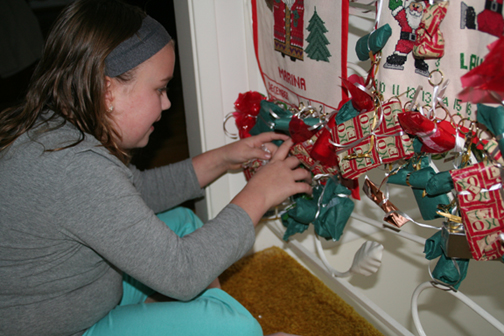
In good old European tradition, my wife put up the "Advent Calendars", each with 24 little presents attached - for our granddaughters. Each granddaughter will open one present per day, until the 24th of December, at which time we have our family Christmas celebration, with dinner and the giving of Christmas presents. So today, being the first day of December, both opened their first-day present.

The advent calendars themselves are needle-point, made especially for our granddaughters by a very good friend who lives in California. The calendars will always remind us of her - what a wonderful effort to make for "the kids".


Well, the snow which was predicted, and which announced its coming a couple of days ago, has arrived. Some time ago I speculated that the birds would be very happy with the "yellow apples" hanging on our neighbours' tree. Today, that came true.


Here's the snow


...and the birds are having a feast.

Thursday, November 29, 2007

A sign of winter

On clear autumn days, we get an excellent indication of how close winter is by looking out our window and taking notice of the snow line on our local mountains. Right now, the line is "descending" and is not too far above the elevation at which our house is located. This likely means that I'll be shovelling snow in a few days.

Of course, the snow line will have its "ups and downs" . In our area, being located more-or-less on the shores of the Pacific Ocean, weather patterns often bring a surge of warm and moist air from as far away as Hawaii, or even the South Pacific - which usually means rain. So this line is likely to move up and down in the coming weeks. Of course, as spring approaches, the line will "ascend" in a similar manner.

Well, regardless of what is heralded, it's just "plain beautiful" (is this an oxymoron?)

Friday, October 26, 2007

A moonrise from the window

Having just returned from California, it is a nice surprise to have a beautiful, clear day and evening - free of all the smoke. Even more lovely was the full moon rise over the northeast mountains, as viewed from our living room window (see picture).


The full moon always appears opposite the sun in the sky. At this time of year the sun sets fairly low in the southwest (and it'll get lower still until December 21). This means that the full moon rises high in the northeast, and sets high in the northwest. In the summer, the sun rises and sets that way, and at that time the full moon rises low in the southeast and sets low in the southwest. A quick rule of thumb: summer sun equals winter full moon, summer full moon equals winter sun. You can also say that sun and full moon are always two seasons apart.


The picture on the left was taken through a double-paned window and shows some faint smudges and reflections as a result. It is actually a combination of two pictures, one exposed to show the bushes, trees and mountains, the other to show the details in the moon's "face". In the first picture the bushes and mountains are correctly exposed, but the moon is overexposed and shows no detail. In the second picture (not shown in this posting), the moon is correctly exposed, but the bushes are barely visible. Consumer type digital camera CCDs do not have the dynamic range of the human eye; the eye perceives detail in both bright and dark areas at the same time. Using Photoshop, the two pictures were combined to give the same impression that I had when I looked at the scene.


This picture is one of several which were taken from the front steps a little later. The histogram of the moon's image in this picture was adjusted to bring out the detail, and the contrast in the whole picture was increased to enhance the appearance of the bushes. This is a single picture, not the combination of two. It played no part in the combined picture above.

Sunday, September 30, 2007

Fall is here


The weather here today, and for the next three or four days is indicative of what fall is like in this area. The sky is grey, and the rain is coming down. In anticipation of that, yesterday I went up on the roof to make sure that the downpipes are clear of debris and that the roof was ok.

Oh, the joys of Fall.
Derek and his family have taken a minivacation in Victoria over the weekend - we're glad that he's feeling well enough to do that. They are staying at a nice hotel - swimming pool and other amenities - a little "pretend summer". We'll "veg out" here today; no point in getting dressed. The granddaughters' fish need their daily feeding - we are looking after that. After all, what are grandparents for?

Tuesday, September 25, 2007

Who stole them?

Today is one of the typical fall days that are common in our area during this time of year. Here are two pictures taken from our living room window comparing a nice, sunny late fall day of last year to today. Somebody seems to have stolen the mountains.

Today


Last year


Our Mexican guests left yesterday; it seems as though they took the nice weather with them.